

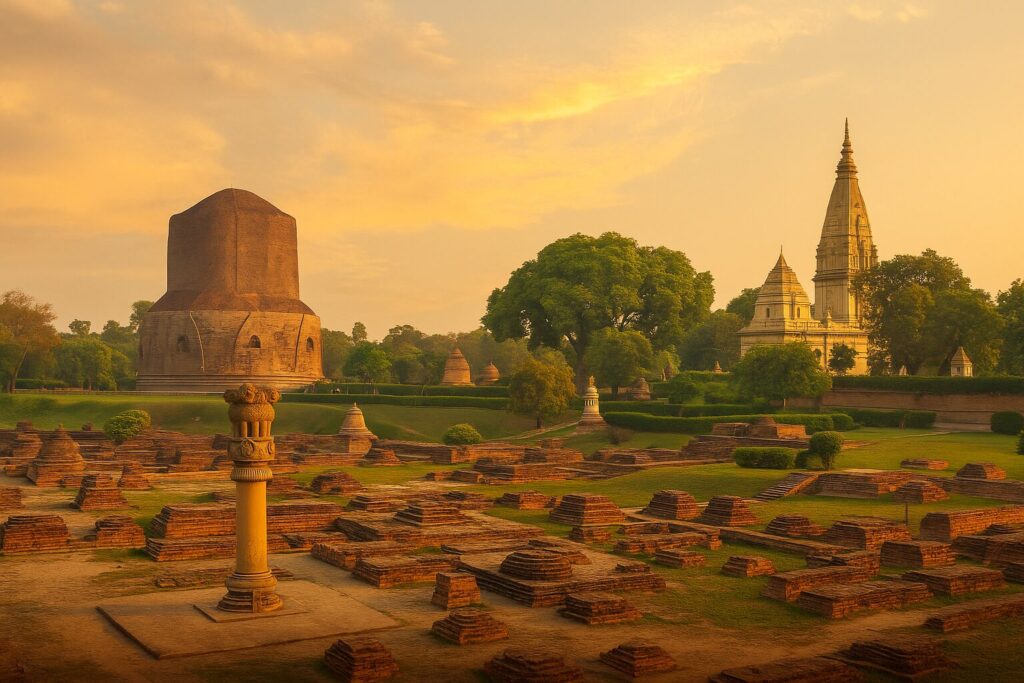

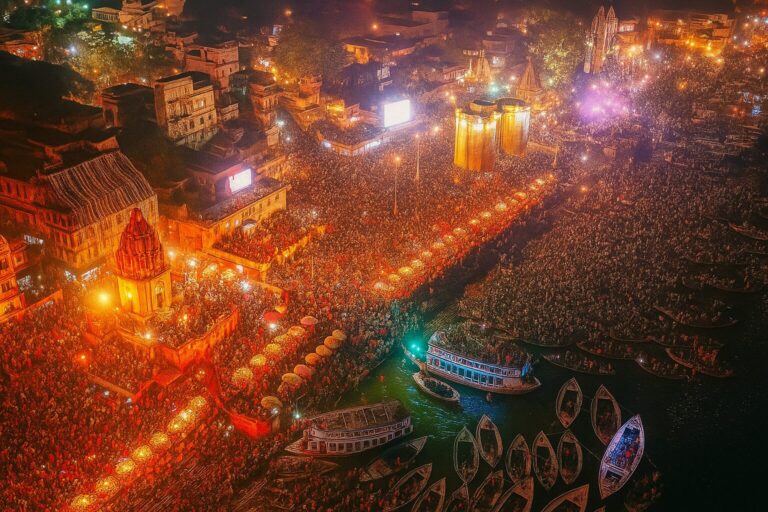
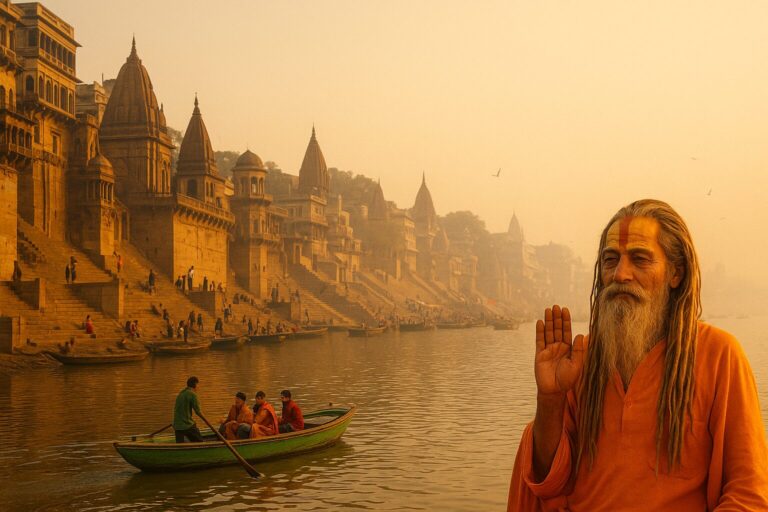
If Varanasi (Banaras) is the city of Shiva—of chaos, impermanence, and the ever-turning cycle of life and death—then Sarnath is its silent, contemplative counterpart.
As someone who has lived in Banaras for years, I have seen countless travellers make the same mistake. They treat Sarnath as a quick tick-box excursion—a two-hour dusty detour to see a few ruins before rushing back. But Sarnath is not just an archaeological site. It is the cradle of a philosophy that changed the course of human thought. This is where history, spirituality, and culture intertwine deeply, offering an experience that deserves far more than a fleeting visit.
In this comprehensive guide, I will take you through everything you need to know to explore Sarnath like a local—from its spiritual significance to practical, on-ground tips on how to experience it meaningfully. Consider this your companion to understanding Sarnath in all its depth and quiet power.
What distinguishes a meaningful Sarnath experience:
- Spending time in contemplation, not just observation
- Understanding the deeper Buddhist philosophy, not just the historical facts
- Experiencing the site’s spiritual energy alongside its archaeological significance
- Connecting Sarnath’s teachings with Varanasi’s living spiritual traditions
This isn’t to say you need days to appreciate Sarnath. But you do need intention. You need to arrive not just with your camera, but with your curiosity and, perhaps most importantly, with time to simply be present.
Where Is Sarnath & Why It Matters Spiritually
Geographically, Sarnath is located about 10 to 13 kilometres north-east of Varanasi Cantt Railway Station, near the confluence of the Ganges and the Varuna rivers.
Spiritually, it is one of the four most important pilgrimage sites for Buddhists (the others being Lumbini, Bodh Gaya, and Kushinagar).
In ancient texts, this place was known by two names:
- Rishipatana (Isipatana): The place where holy men (Rishis) fell or landed.
- Mrigadava: The Deer Park. Legend says the King of Kashi declared this area a sanctuary for deer, a tradition that continues today with the deer park inside the complex.
It matters because this is the birthplace of the Sangha (the community of monks). Before Sarnath, the Buddha was an enlightened individual. After Sarnath, Buddhism became a movement.
The Story of Sarnath (Buddha’s First Sermon)
To enjoy your visit, you don’t need a degree in history, but you do need the context.
Around 528 BCE, Siddhartha Gautama attained enlightenment under the Bodhi tree in Bodh Gaya. He became the Buddha (the Awakened One). But enlightenment is a lonely peak. He debated whether to keep this profound realization to himself or try to teach a world steeped in ignorance.
He chose to teach. He walked over 200 kilometres from Bodh Gaya to Sarnath to find his five former ascetic companions who had previously abandoned him.
Here, at the spot now marked by the Dhamekh Stupa, the Buddha delivered his first sermon—the Dhammacakkappavattana Sutta, often translated as “Setting the Wheel of Dharma in Motion.” With this teaching, a spiritual path was articulated for the first time, one that would travel far beyond Sarnath and shape the lives of millions across centuries.
At the heart of this sermon lie the Four Noble Truths, simple in structure yet profound in depth:
-
The Truth of Suffering (Dukkha)
Life inevitably contains suffering, dissatisfaction, and unease. This arises from the impermanent and ever-changing nature of existence. -
The Truth of the Cause of Suffering (Samudāya)
The root of suffering lies in craving—desire, attachment, and clinging—often driven by ignorance of reality as it truly is. -
The Truth of the End of Suffering (Nirodha)
Suffering can cease. By letting go of craving and attachment, one can experience liberation and attain Nirvana. -
The Truth of the Path Leading to the End of Suffering (Magga)
The way forward is the Noble Eightfold Path, a balanced path of ethical living, mental discipline, and wisdom—encompassing right understanding, intention, speech, action, livelihood, effort, mindfulness, and concentration.
The Middle Way
Central to the Buddha’s first sermon at Sarnath is the idea of the Middle Way—a path of balance that avoids the two extremes he had personally experienced. On one end lay a life of indulgence and sensual excess; on the other, severe asceticism marked by self-denial and physical suffering. The Buddha realised that neither led to true understanding or liberation.
How Much Time Do You Really Need in Sarnath?
This question reveals more about your travel philosophy than you might expect. The standard answer—3 to 4 hours—satisfies most practical requirements. You can see the main sites, visit the museum, and return to Varanasi comfortably within this timeframe.
For those deeply interested in Buddhism or history, consider spending more time
But I’ve learned that asking “How much time do you need?” is like asking “How long should you spend appreciating a sunset?” The answer depends on what you’re seeking.
Here’s a rough breakdown of how you might spend your time:
- Half-day visit (3-4 hours): Dhamekh Stupa, Sarnath Archaeological Museum, and a quick look at the monasteries.
- Full-day visit (6-8 hours): In-depth exploration of the stupa, museum, monasteries, and some quiet time for reflection.
- Extended visit (more than a day): For those who want to delve deeper into the spiritual and historical aspects, consider spending more time, perhaps even participating in meditation sessions or talks at the monasteries.
Factors that affect your timing:
- Your interest level in Buddhism and meditation
- Whether you prefer solitude or don’t mind crowds
- Your comfort with heat (important in summer months)
- Whether you’re travelling with others who share your pace
- Your energy levels after exploring Varanasi
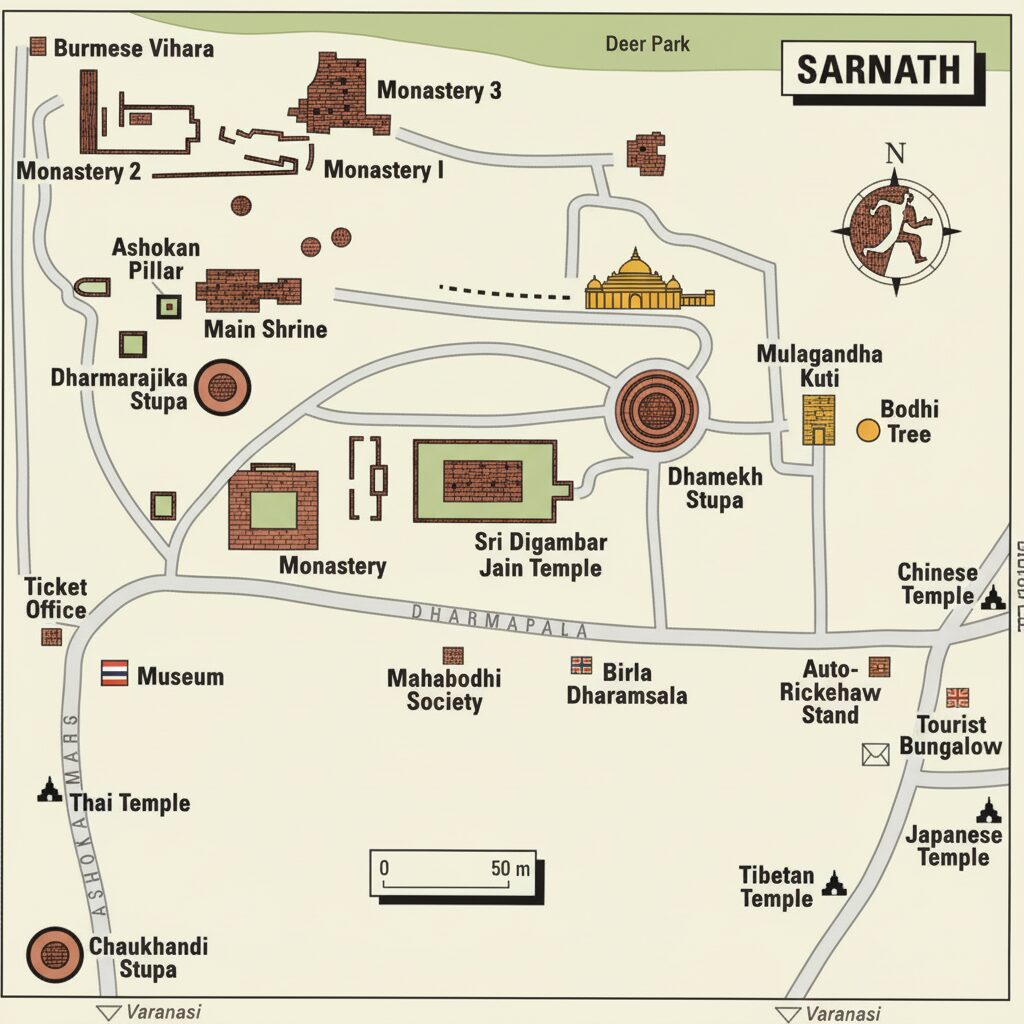
How to Explore Sarnath Step-by-Step (Ideal Walking Flow)
Many visitors get dropped off at the museum, wander aimlessly, and miss the narrative flow. Here is the logical route I recommend to my friends visiting Banaras.
The Gateway: Chaukhandi Stupa
Located about 600 metres south of the main Sarnath Buddhist complex, Chaukhandi Stupa is a striking brick structure, instantly recognisable by the octagonal tower crowning its summit. The name Chaukhandi is derived from the stupa’s original four-armed ground plan. In recognition of its historical value, the monument was declared of national importance by the Archaeological Survey of India in June 2019.
The stupa finds its earliest written mention in the accounts of the Chinese monk-scholar Xuanzang, who travelled extensively across northern India between 634 and 645 CE. His records confirm that a stupa already stood here by the mid-7th century.
Archaeological excavations conducted in 1835 and later in 1904–05 revealed stepped terraces—most prominent on the eastern side—dating back to the Gupta period (4th–6th century CE). These excavations also unearthed a seated image of the Buddha in dharmachakra mudra, a Bodhisattva figure, and finely carved bas-reliefs depicting leogryphs and gladiators.
During the 1835 excavations, Alexander Cunningham sank a vertical shaft through the centre of the stupa in search of relic chambers. Despite reaching the foundation layers, no relics or significant finds were discovered.
The octagonal tower that now defines Chaukhandi Stupa is a much later addition. It was commissioned in 1567 by the Mughal emperor Akbar in memory of his father Humayun, who had visited Sarnath in 1532. The construction was overseen by Govardhan, the son of Raja Todar Mal.
Slightly removed from Sarnath’s main cluster of monuments, Chaukhandi Stupa often feels overlooked. Yet this very separation lends it a quiet charm. Surrounded by open lawns and far from the usual crowds, it offers a sense of solitude and calm—an ideal place to pause before or after exploring the busier heart of Sarnath.
The Main Excavation Site (Ticketed Area)
This is the heart of Sarnath. Do this early to avoid the heat and crowds.
- Dharmarajika Stupa: You will see only the foundations here. This was once a massive stupa built by Emperor Ashoka to house the Buddha’s relics, but it was dismantled in the 18th century by a local ruler to use the bricks for construction—a tragic loss of history.
- Ashoka Pillar: Look for the fragments of the pillar under a canopy. The famous Lion Capital sat on top of this.
- Mulagandhakuti Vihara (Ancient): The ruins of the Buddha’s meditation hut. It is often filled with pilgrims chanting and lighting incense.
- Dhamekh Stupa: The towering finale of the complex.
Sarnath Archaeological Museum: What to See & Skip
This is the oldest site museum of the Archaeological Survey of India (ASI), and arguably one of the best in the country.
Important Rule: You are not allowed to take cameras or mobile phones inside (allowed in most sections for a small additional fee). There are lockers at the entrance, but the queues can be long. If you have a driver, leave your bags in the car.
Must-See Highlights:
- The Lion Capital of Ashoka: This is the original sculpture that serves as India’s National Emblem. Seeing it in person is distinct from seeing it on currency notes. The polish on the sandstone, known as the “Mauryan Polish,” still gleams after 2,300 years.
- The Teaching Buddha (Dharmachakra Pravartana Mudra): Many art historians consider this the most perfect sculpture of the Buddha ever created. Carved in the 5th century, the serenity on the face is mesmerising.
- The Bodhisattva: A massive standing figure of red sandstone dedicated by a monk named Bala.
What to Skip: If you are short on time, you can breeze through the galleries containing smaller pottery fragments and focus solely on the major sculptures in the main hall.
Mulagandhakuti Vihara (Modern)
Mulagandha Kuti Vihara lies about 400 metres east of the main entrance to the Sarnath Buddhist complex and was completed in 1931. The temple is closely associated with Anagarika Dharmapala, the Sri Lankan Buddhist reformer who founded the Maha Bodhi Society in 1891 to revive Buddhism in India and restore its most sacred sites, including Bodh Gaya, Sarnath, and Kushinagar.
Dharmapala’s vision took shape after his pilgrimage to Sarnath and Bodh Gaya in 1891, where he was deeply affected by the neglected condition of Buddhist monuments and the marginalisation of Buddhist worship. Through the Maha Bodhi Society, he travelled widely to build international support for the revival of Buddhism in its land of origin, including representing the tradition at the World Parliament of Religions in Chicago in 1893.
The site for Mulagandha Kuti Vihara was deliberately chosen close to where the Buddha is believed to have delivered his first sermon, placing it just east of the Dhamekh Stupa. The temple enshrines sacred relics of the Buddha discovered during archaeological excavations at Nagarjunakonda and Taxila, later entrusted to the Maha Bodhi Society.
Today, the vihara is especially known for its striking frescoes depicting scenes from the Buddha’s life, painted by the Japanese artist Kosetsu Nosu and completed in 1936. These murals, restored in recent years, reflect the global Buddhist connections that shaped modern Sarnath. Nearby stands a Bodhi tree sapling planted in 1931, believed to descend from the original tree at Bodh Gaya via Sri Lanka.
Anagarika Dharmapala passed away in Sarnath in 1933, just two years after the vihara opened. The Mulagandha Kuti Vihara remains one of the most important modern Buddhist monuments in Sarnath, quietly linking the ancient site to the global Buddhist revival of the twentieth century.
The International Monasteries
Sarnath feels like a mini-United Nations of Buddhism. Each country has built a temple in its own architectural style.
Thai Temple (Wat Thai Sarnath)
Famous for the 80-foot tall standing Buddha statue. It is majestic and visible from afar. The gardens here are manicured and peaceful.
Tibetan Temple
Guarded by two stone lions, this temple features the famous prayer wheels. Spin them clockwise as you enter. The interior is filled with vibrant Thangka paintings and a heavy scent of butter lamps.
Japanese Temple (Nichigai Suzan Horinji)
My personal favourite for quiet contemplation. The architecture is distinctly Japanese—minimalist wood, sloping roofs, and a scent of sandalwood. The “Karuna” (Compassion) statue here is beautiful.
Sri Lankan Temple
This is the Mulagandhakuti Vihara mentioned earlier. Visit during the evening chanting (around 6:00 PM) to hear the rhythmic beating of drums and chanting of suttas.
Chinese Temple
Located about 650 metres east of the main entrance to the ancient Buddhist complex, near the Mulagandha Kuti Vihara, the Chinese Temple is a modest yet deeply tranquil space. Like many monasteries in Sarnath, it remains relatively quiet and uncrowded, making it an ideal place for a moment of calm reflection. Established in 1939 by Tao-Kai, the abbot of Beijing, along with Fa-Yuan-Tsu of the Eastern Asian Buddhist Association, the temple stands on land that was once a vegetable plot and mangrove. A noteworthy feature here is an information board tracing the journey of the Chinese monk-scholar Xuanzang (Hiuen Tsang), who travelled across northern India in the 7th century, leaving behind detailed accounts that remain invaluable to historians and scholars today.
Korean Temple (Nokyawon)
This is a serene monastery located near the Pink Temple in Sarnath, built in 1995 to accommodate Korean pilgrims. Set amid well-kept lawns, it features a distinctive Korean-style stupa that stands apart from the more familiar forms seen elsewhere in Sarnath. The calm surroundings invite quiet exploration, and the monastery also houses a small but rare collection of books, with assistance available for visitors interested in learning the Korean language.
Sivali Vietnamese Buddhist Temple
This is instantly recognisable for its one-pillar pagoda—a striking example of Vietnamese architectural style, crowned with a bell. The complex also includes a small prayer hall and a modest guest house for Vietnamese monks. The monk who envisioned and built the temple continues to live here and personally looks after the premises, adding to its quiet, lived-in authenticity.
The temple was built by a Vietnamese monk, Doan Lam Tan, whose journey to Sarnath is as remarkable as the structure itself. Once living an ordinary life in Vietnam, Doan experienced deep unrest after declining a monk’s request to help build a Buddha temple in India. A vivid dream soon followed, urging him to travel to the land of the Buddha and fulfil his life’s purpose. Moved profoundly, he sold his belongings and travelled to India, eventually arriving in Sarnath.
Over the next few years, Doan tirelessly raised funds through Buddhist communities, monks, and supporters across Vietnam. The foundation stone was laid in December 2009, and after five years of dedicated effort, the Sivali Vietnamese Temple finally took shape—a testament to faith, perseverance, and devotion.
Cambodian Monastery
This is located just a few metres from the Tibetan Monastery, is a quiet and modest complex. At its heart stands a small temple enshrining a 4.5-foot statue of Lord Buddha.
Other Spiritual Sites & Offbeat locations
Digambar Jain Temple (Shreyanshnath Tirth)
Sarnath also holds deep significance for followers of Jainism. It is closely associated with Shreyanshnath, the 11th Jain Tirthankara, who is believed to have been born in a village near Sarnath. Built in 1824, the Shri Digambar Jain Temple (Shreyanshnath Birthplace) is therefore an important Jain pilgrimage site and is often referred to simply as the Shreyanshnath Jain Temple.
The temple houses a large image of Shreyanshnath and features frescoes depicting episodes from the life of Mahavira, the last and most revered Tirthankara of Jainism. Reached via a peaceful path lined with greenery, the temple offers a calm and contemplative atmosphere, distinct from the busier Buddhist sites nearby.
In Jain philosophy, a tirthankara is one who has crossed beyond worldly attachments and shown others the path to liberation. Sarnath’s importance is further underscored by the belief that four Tirthankaras were born in the wider Varanasi region, making it a place of reverence for Jain devotees. For followers of the Digambar tradition in particular, a visit to this temple is considered an essential part of their pilgrimage to Sarnath.
Sarnath International Nyingma Institute
The Sarnath International Nyingma Institute is an important centre of Tibetan Buddhism in Sarnath, associated with the Nyingma tradition, the oldest school of Tibetan Buddhism. Established to preserve and transmit classical Buddhist learning, the institute functions both as a monastic centre and a place of higher studies.
The complex includes a monastery, a college, and residential facilities for monks from India and abroad. Teachings here focus on Buddhist philosophy, meditation, logic, and Tibetan language, following traditional monastic curricula. Compared to the more visually striking temples in Sarnath, the Nyingma Institute has a quieter, more academic atmosphere, reflecting its role as a living centre of study rather than a tourist landmark.
For visitors, the institute offers a glimpse into contemporary monastic life in Sarnath. While access to inner areas may be limited, simply walking past the campus helps complete the picture of Sarnath—not just as an archaeological site, but as an active centre of Buddhist learning that continues to evolve.
Ganga Darpan Centre
The Ganga Darpan Interpretation Centre, located within the Forest Department campus at Sarnath, is an interactive centre dedicated to the cultural, ecological, and historical significance of the river Ganga. Established in 2019 under the Namami Gange project and developed by the Wildlife Institute of India, it aims to build awareness around river conservation and biodiversity.
A detailed 3D model traces the Ganga’s journey from the Himalayas to the plains, highlighting key pilgrimage sites, protected areas, and aquatic life such as dolphins, turtles, and crocodiles. With interactive panels, QR codes, and displays on birdlife and history, the centre offers a quiet, informative pause for visitors seeking context beyond temples and ruins.
Light & Sound Show at Dhamek Stupa
The Sarnath Light and Sound Show is a relatively recent addition, launched in 2020 after nearly 18 years in the making. Set against the backdrop of the Dhamek Stupa, the show narrates the story of Varanasi, the life of Gautam Buddha, and the spiritual significance of Sarnath through sound, light, and visuals. The narration, voiced by Amitabh Bachchan, brings the ancient site to life after sunset.
The show lasts about 30 minutes and usually begins around 6:30 PM. Entry is limited to around 50 visitors per day on a first-come basis, so it is advisable to reach the archaeological site at least 2–3 hours in advance. Tickets can be purchased at the entry gate of the Sarnath Archaeological Complex.
Originally free, the show now charges a nominal fee—₹200 for Indian visitors and ₹250 for foreign visitors. As dusk falls and the stupa is illuminated, the experience offers a fitting, reflective conclusion to a day spent exploring Sarnath.
Quick Info
-
Location: Dhamek Stupa
-
Entry Time: Around 5:30–6:00 PM
-
Show Time: Around 6:30–7:00 PM
-
Ticket Price: ₹200 (Indians) | ₹250 (Foreigners)
How to Reach Sarnath from Varanasi
- By Auto/Taxi: Easily accessible by auto-rickshaw, Ola, or local taxi from any part of Varanasi (30-40 min).
- By Train: Sarnath has a small railway station with limited services.
- By Bus: Frequent buses from Varanasi Junction.
Best Time to Visit
- Morning to Early Afternoon (8 AM – 2 PM) is ideal. This allows you to visit the open-air stupas and ruins before the sun gets harsh.
- October to March is the most pleasant season.
- Light & Sound Show happens in the evening, perfect to wind up your visit.
Tip: You can walk through this international temple trail in about 60–90 minutes.
Suggested Half-Day Walking Itinerary
| Time | Place |
|---|---|
| 8:00 AM | Start at Chaukhandi Stupa then Wat Thai Temple |
| 8:45 AM | Visit Ashoka Pillar , Archaeological Site, Dhamekh Stupa |
| 9:45 AM | Explore Sarnath Museum |
| 10:30 AM | Walk to Jain Temple then Mulagandha Kuti Vihara & Deer Park |
| 11:30 AM | Begin International Temples/Monasteries Walk (e.g., Tibetan, Chinese, Japanese) Choose 2-3 to visit based on the available time |
| 12:30 PM | End at Sivali Vietnamese Temple |
Optional :
- Return in evening for Light & Sound Show.
Final Tips for Visitors
- Footwear: Easy-to-remove footwear for temples.
- Clothing: Modest dress recommended.
- Water & Hat: Essential in warmer months.
- Local Guides: Available outside main sites.
- Photography: Allowed at most places (except some parts of the museum).
Is Sarnath Worth Visiting? (Honest Answer)
After years of accompanying different types of visitors to Sarnath, I’ve learned that this question reveals as much about the person asking as it does about the destination itself. The honest answer is: it depends entirely on what you’re seeking and how you approach the experience.
Sarnath excels if you’re:
Interested in Buddhism: Obviously, but beyond casual interest. If you’ve read about Buddhist philosophy, practiced meditation, or feel drawn to understanding suffering and compassion more deeply, Sarnath offers irreplaceable authentic experience.
Seeking contemplative travel: Unlike many tourist sites that stimulate through visual spectacle, Sarnath rewards quiet observation and reflection. If you prefer depth over breadth, meaning over entertainment, this place delivers.
Appreciating historical significance: Standing where world-changing philosophy was first articulated creates a powerful connection to human intellectual and spiritual development.
Comfortable with simplicity: Sarnath isn’t visually dramatic like the Taj Mahal or socially vibrant like Varanasi’s ghats. Its power lies in subtlety and atmosphere.
Sarnath might disappoint if you’re:
Expecting visual grandeur: The ruins, while historically significant, aren’t architecturally spectacular. If you need immediate visual impact, other destinations serve better.
Rushed for time: Sarnath’s gifts unfold slowly. Quick visits often feel anticlimactic.
Seeking social energy: This is a place for introspection, not interaction. If you thrive on bustling markets and constant stimulation, you might find Sarnath quiet.
Uninterested in philosophy or spirituality: Without context about Buddhist teachings or appreciation for contemplative experiences, Sarnath can feel like “just old stones.”
The middle ground reality: Most visitors fall between these extremes. They arrive with mild curiosity and leave with either deeper appreciation or polite indifference. The determining factor is usually approach—those who engage thoughtfully with the site’s significance have much richer experiences than those treating it as a photo opportunity.
Ready to explore Sarnath with us? Book a guided tour or stay at our curated homestays just 30 minutes away from this ancient marvel.